
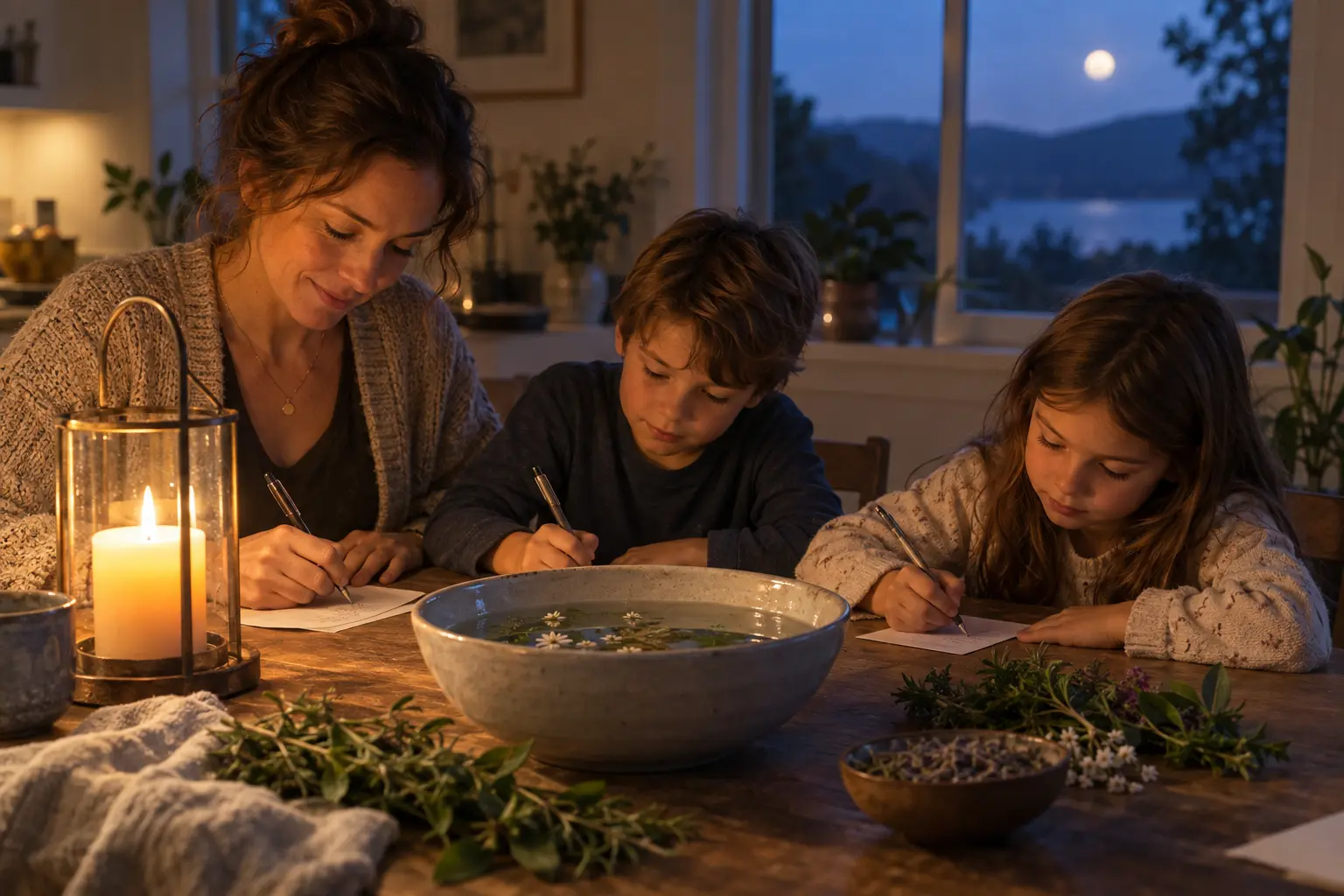
Family ritual should not require children to become quiet little adults in matching pajamas while the moon waits photogenically outside the window. Real children wiggle, interrupt, refuse, become hungry, argue over who lights the candle, and suddenly need to tell you a seventeen-minute story about a rock. A ritual that only works when children stop being children is not a family ritual. It is a performance.
I want our spiritual life to teach attention, consent, gratitude, emotional language, and connection. I do not want it to teach that Mom's spiritual vision matters more than a child's body signals. That means participation is invited, not forced. Passing is allowed. Watching is participation. Leaving the table is allowed. A child does not owe the circle a vulnerable disclosure.
This moon ritual works for a new moon, full moon, seasonal threshold, difficult family week, or ordinary evening when everyone needs to come back together. You can call it a moon circle, family reset, gratitude night, or nothing at all. The name matters less than the safety of the container.
Decide what the ritual is for
Choose one purpose. Do not ask a single evening to hold release, manifestation, ancestral healing, family conflict repair, gratitude, divination, and a craft. For a new moon, the purpose might be choosing one quality the family wants to practice. For a full moon, it might be noticing what has grown and releasing one habit. After a hard week, it might simply be reconnecting without solving everything.
Say the purpose plainly: “Tonight we are taking fifteen minutes to notice what was hard, what helped, and what we want to carry into next week.” Clear purpose lowers uncertainty for children and keeps adults from expanding the ritual after everyone is tired.
Set a container that respects real nervous systems
Pick a maximum length before you start. Ten to twenty minutes is enough for most families. Feed people first. Allow comfort objects. Keep the lights bright enough for anyone who dislikes darkness. Use a candle inside a stable lantern, an LED candle, or no flame. Do not use smoke around children, pets, asthma, migraine, or sensory sensitivities.
Tell everyone what will happen in order. For example: we will light the lantern, take three breaths, answer one optional question, place herbs in water, and close with a snack. Predictability is not less magical. It creates the safety that lets attention deepen.
Offer roles without assigning spiritual status. One child can carry the bowl. Another can choose the closing song. Someone can set napkins for the snack. A child who does not want a role can sit nearby and draw.
Gather ordinary materials
- A safe lantern or LED candle
- A bowl of water
- Small pieces of paper and pencils
- A garden herb such as rosemary, mint, lavender, or basil
- A towel for spills
- A simple closing food such as apple slices, bread, popcorn, or tea
Choose herbs you can identify and handle safely. Do not ask children to ingest ritual herbs unless they are ordinary food ingredients prepared in a safe amount. The bowl of water is symbolic and practical. It gives busy hands something to do.
Open the circle without demanding stillness
Light the lantern and say: “We are making a small pause together. You may join, watch, draw, or pass. We will listen without fixing each other.” Ask everyone to notice one thing they can see, one sound they can hear, and one place their body touches the chair or floor.
Take three normal breaths. Do not instruct children to breathe deeply if that makes them uncomfortable. You can invite a candle breath: smell an imaginary flower, then gently cool imaginary soup. Keep it playful and optional.
Choose one honest question
Use one question, not a list. Good questions are specific enough to answer and open enough to be real:
- What is something you did this week that took courage?
- What felt heavy that you do not want to carry alone?
- What helped you feel like yourself?
- What would make home feel kinder this week?
- What are you grateful your body helped you do?
Adults answer too. Model an answer that is honest without making children responsible for adult emotional care. “I felt overwhelmed when the schedule changed. Walking outside helped me settle.” Avoid disclosures that make a child feel they must rescue, reassure, or take sides.
If someone passes, say, “Thank you for knowing what you need.” This teaches that boundaries belong inside spiritual community, not outside it.
Create a release that does not shame emotion
Invite each person to write or draw something they are ready to put down. Younger children can choose a color or make a mark. Fold the papers and place them under the bowl rather than burning them. Say: “We are not getting rid of feelings. We are releasing the job of carrying them alone.”
Each person can add a leaf of rosemary or mint to the water. As the surface changes, name what the family is choosing instead: more rest, clearer words, asking sooner, softer mornings, fewer activities, more outside time.
Afterward, pour the water onto an outdoor plant if the ingredients are plant-safe, or strain it and pour it down the sink. Tear the papers privately or keep them in a family journal. Do not read a child's paper without permission.
Add a new-moon intention or full-moon reflection
For a new moon, let each person choose one quality rather than one achievement. “I want to practice patience when I am frustrated” is more workable than “I will never yell.” Ask what tiny action supports the quality. Patience might mean putting a glass of water beside the homework space or using a code word when someone needs a pause.
For a full moon, ask what has grown since the last month. Children may name a skill, friendship, plant, tooth, confidence, or collection. Adults can name internal growth without making it grand. “I asked for help twice” counts. “I rested before I became sick” counts.
Close the ritual through the senses
Closing matters because it tells the body the container has ended. Thank everyone for whatever level of participation they chose. Extinguish the candle or switch off the lantern. Wash hands. Eat the snack. Put on one familiar song. The return to ordinary life is part of the ritual.
A simple closing script is: “This circle is complete. What we shared belongs to each person. May our home hold truth, respect, rest, and repair. Now we return to our evening.”
What to do when the ritual falls apart
If siblings fight over materials, pause and separate the materials. If a child laughs during a serious moment, remember that laughter can release tension. If someone becomes distressed, stop the ritual and respond to the person. If nobody wants to participate, light the lantern for yourself after bedtime. Consent does not ruin the magic. Consent is part of the magic.
Real-life example: One child answers every question with “I do not know,” another spills the water, and the third disappears. Instead of pushing through, say, “Our bodies are telling us this is enough.” Clean the spill together, eat the apples, and close. The successful outcome is not completing every step. It is showing children that relationship matters more than ceremony.
Use ritual to support repair, not avoid it
A moon circle cannot repair a conflict if nobody takes responsibility. If you yelled, apologize specifically. If a family rule is unfair, change it. If a child needs professional support, seek it. Ritual can create a calm doorway into repair, but accountability must walk through.
Try this repair structure after everyone is regulated: what happened, who was affected, what responsibility belongs to me, what needs to change, and how will we know the change is real? Keep the moon language if it helps, but do not let spiritual language make harm vague.
Build a rhythm without creating another obligation
You do not need to hold a circle every moon phase. Choose one rhythm your family can sustain: the first Sunday of the month, the full moon nearest a weekend, or four seasonal gatherings each year. Keep a basket with the lantern, bowl, pencils, and planner so setup takes five minutes.
Let the ritual mature with your children. A six-year-old may want to float leaves. A teenager may prefer tea at the counter and one honest question. Connection changes form. The sacred part is not preserving the original format. It is continuing to meet one another truthfully.
I want our children to know spirituality as a place where their no is respected, their feelings do not frighten the adults, and the ordinary world is worthy of attention. I want them to see that a sacred home is not a silent home. It is a home that knows how to pause, listen, repair, and begin again.